11th November in Venice
What is celebrated in Venice on the 11th November? Let’s find out together…
By Alessandra Ivaldi / 12.11.2025
A personal experience. Exactly one year ago I first encountered the Venetian tradition of San Martino, celebrated on the 11th November. I was familiar with the legend of the saint, which is still told to children at school, but I had no idea how important this event was in the city of Venice. Imagine my amazement when, last year on the 11th November, on a very normal day at work, I found myself in front of this peculiar scene: students from all classes, from the youngest to the oldest, were offering large, colorful sweets to teachers and classmates. For them it was an absolutely normal situation, for me a completely unexpected surprise. What did those sudden offers mean? My amazement left the students somewhat perplexed and eventually the roles were reversed and they taught me something new.
The legend. Let's start from the beginning, that is, from the legend. A Roman soldier named Martin was making a horseback patrol in the French city of Amiens, when he encountered a beggar dressed only in rags on his path. It was a cold autumn evening and the beggar would surely have died of the cold, but Martin cut his cloak in half and gave a piece to him, so that he could shelter from the frost. According to the legend, after this gesture, the sky suddenly cleared and the temperature became milder, as if summer had suddenly returned. For this reason, even today we speak of “St. Martin's summer” referring to unusually mild and sunny days during the month of November. That very night Martin saw Jesus in a dream, wrapped in the cloak he had given to the beggar. It was the year 335 AD and after this episode Martin converted to Christianity and began a new life, dedicated to fighting injustice and helping the weakest. In 371 he was appointed bishop of Tours and in 397 he died in Candes-Saint-Martin, a French town that not surprisingly owes its name to the famous saint.
In Venice. For a long time Venetians have paid homage to the figure of Saint Martin with a curious tradition. Every year, on the 11th November, children used to walk around the city with a paper crown on their heads, banging cowbells and pots. Their noise reached every corner of the city. Amused spectators gave them small gifts, sweets or some money.
Today this tradition is gradually disappearing, replaced by similar but more “trendy” festivities like Halloween. However, it is still sometimes possible to meet children wandering through the streets of Venice and noisily celebrating St. Martin's Day. Moreover, schools with a sufficiently large courtyard organize shows, which include the arrival of Saint Martin on horseback, who distributes sweets to the children.

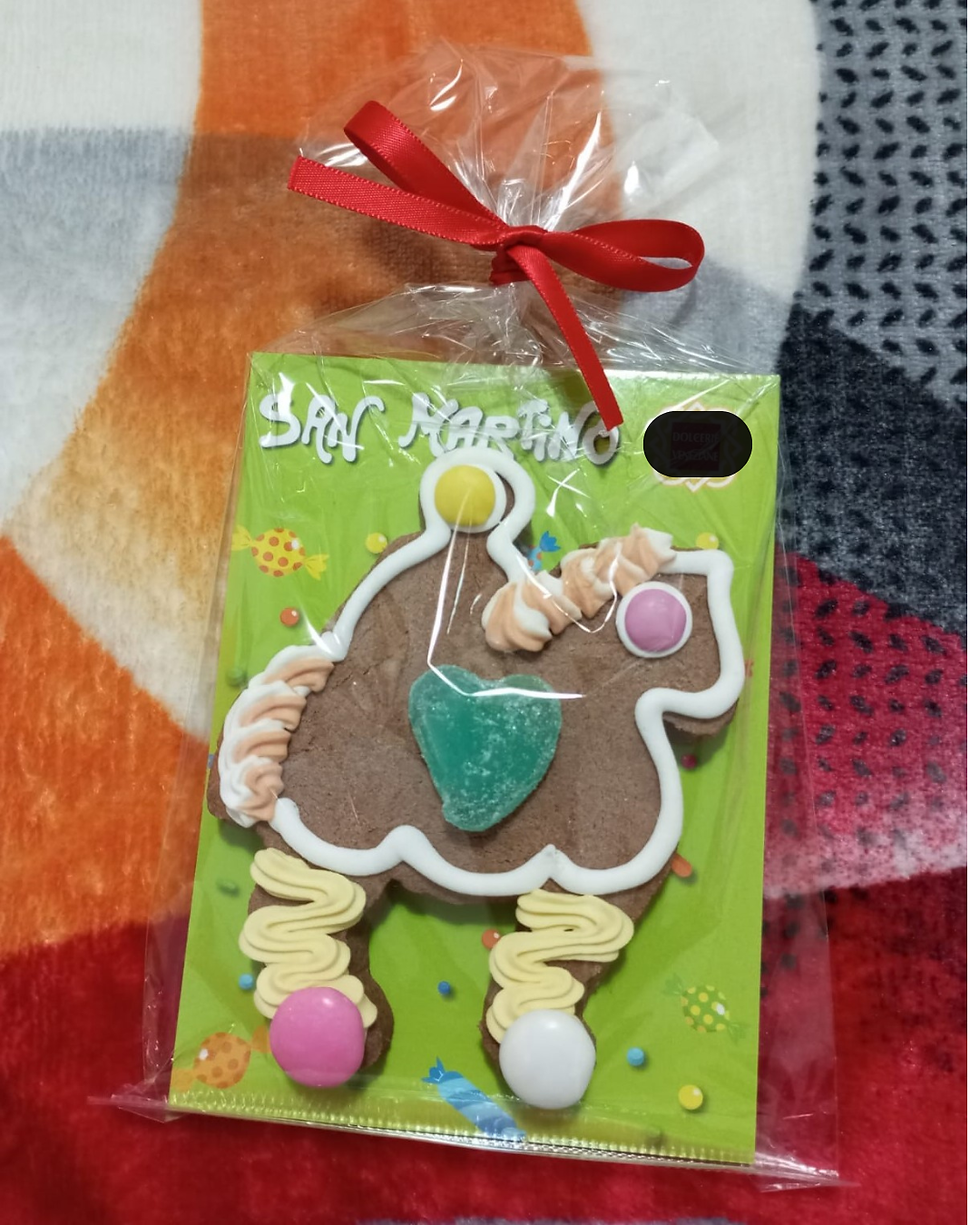
The cake. There is a particular aspect of the tradition that is not only not disappearing, but even seems to be gaining new popularity every year: the cake of San Martino. It is a large shortcrust pastry biscuit, whose shape vaguely resembles that of the saint on horseback. It is covered with chocolate icing and decorated in the most imaginative ways, with sugar paste, sweets or colored pigtails. Chocolate bars are even “glued” onto its larger version.
Children and teenagers prepare many San Martino cakes, by themselves or with the help of their parents. Then they eat one with their family and give the others as gifts to friends, relatives… and even teachers and classmates. And for those who don't have time to prepare the dessert at home, there is always an alternative solution, because around the 11th November the windows and counters of pastry shops and some supermarkets fill up with knights of shortcrust pastry.
But how do you give shortcrust pastry the unusual shape of a man on horseback? There are two options: to purchase the appropriate mold for the San Martino cake, also available online, or to opt for the strategy long used by Venetian families: drawing the knight's silhouette on a sheet of paper and shaping the dough using the drawing as a reference point. After that… it's up to you to unleash your imagination to decorate the biscuit!


Comments