The Secrets of Wenceslas Square
Wenceslas Square is not the first place you think of when planning a trip to Prague. Typically, the focus is on the most historic and evocative part of the city: the Old Town Square with its astronomical clock, Charles Bridge and the majestic castle. However, Wenceslas Square also deserves the attention of visitors, at least for its historical value.
By Alessandra Ivaldi / 20.04.2026
The Story of St. Wenceslaus. Wenceslas Square is located in the so-called New Town of Prague. It is a particularly popular destination for shopping enthusiasts, being home to numerous shops and premises. It does not have the appearance of a traditional square. It resembles a large avenue, whose center is dominated by the equestrian statue of Saint Wenceslaus, Duke of Bohemia, who lived in the 20th century. He deserves credit for having Christianized the country, which led him to bitter clashes with a part of the Bohemian nobility, who wished to remain pagan.
His brother, Boleslaus, also belonged to this group. He disagreed with Wenceslaus on several issues of both religious and political nature and attempted to kill him several times. Despite this, during a duel Wenceslaus decided to spare his life, but his pity proved misplaced. In fact, in 935 Boleslaus finally managed to eliminate his hated brother, having him murdered by some assassins. According to the legend, Wenceslaus died in Stará Boleslav, in present-day Czech Republic, uttering words of love for the Lord with his last breath. His blood would have spread on the wooden floor, staining it indelibly.

The body of the Duke of Bohemia was later transported to Prague and buried in St. Vitus Cathedral, inside the castle. His reputation for sanctity quickly spread and his tomb became an object of veneration and a destination for pilgrimages. Today Saint Wenceslaus is recognized as the patron saint of the Czech Republic. In 1680 the Prague community dedicated a statue to him and placed it in the square dedicated to him. However, the monument was removed and moved inside the castle in 1800. The statue that visitors can admire and photograph today in the center of Wenceslas Square is actually a second version of the monument, dating back to the early 1900s. At the foot of the statue is a small epigraph, representing a prayer from the people of Prague to their patron saint to always protect the city.

The National Museum. Besides the statue of St. Wenceslaus, the square has much more to offer. At one of its ends we find the National Museum, a place of fundamental cultural importance for Prague. It was built at the end of the 19th century in Neo-Renaissance style and houses a huge collection that brings together archaeological, scientific and artistic finds from different historical eras. Unfortunately, beyond the architectural beauty and richness of its collections, this palace also bears traces of dramatic historical events. During the last century it was first occupied by the Nazis, subsequently bombed and finally targeted by Warsaw Pact troops. Fortunately, after the end of the Second World War the palace was carefully restored to its original splendor.
At the museum entrance, embedded in the sidewalk, you can see a large cross. It marks the exact spot where, in 1969, the young student Jan Palach bravely set himself on fire in protest against the occupation of the country by Soviet troops. He died after three days of agony following the terrible burns he suffered, at the age of 20. That very famous episode is traditionally interpreted as the beginning of the Prague Spring.
The mystery of Lucerna Palace. Wenceslas Square is home to other beautiful buildings, such as Wiehl House, home to a rich art collection, and Koruna Palace, clearly identifiable because it is located next to a tower, on top of which a curious pearl crown has been fixed. But the surprises are not over. After the tour of Wenceslas Square, you should look for Lucerna Palace, a building located on a side street.
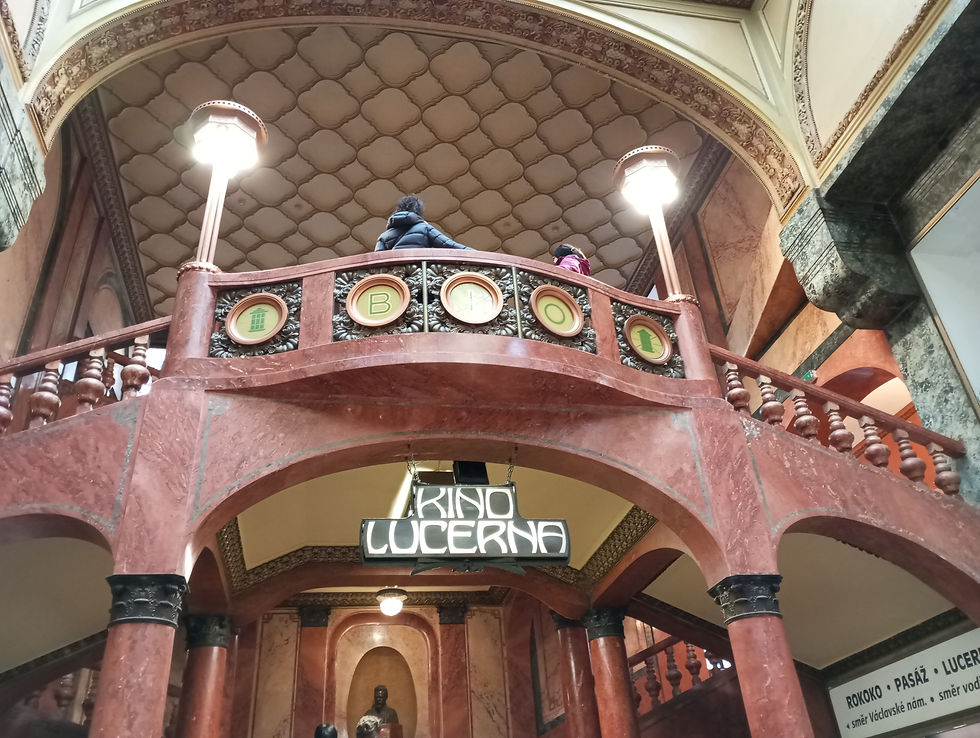
It is a beautiful Art Nouveau gallery dating back to the 1920s, which still exudes the atmosphere of a Prague of times gone by. Here you can find several cafés, restaurants, shops, a cinema and a concert hall. As you enter the gallery, you cannot help but look up and be amazed, because above your head you will see one of the strangest things all over Prague: St. Wenceslaus suspended in the air, sitting on the belly of a dead horse, hanging by his paws from the ceiling. No, it is not a hallucination. It is one of the most controversial works of art in the Czech Republic.
This very strange statue represents one of the most famous works by Prague artist David Černý, known for his large installations scattered throughout Prague. They are always characterised by a very obscure meaning. A famous example of this are his disturbing and gigantic bronze children crawling on the island of Kampa, on the Vltava River, their faces brutally defaced by a kind of enormous barcode.

But returning to Wenceslaus, Černý’s work is perhaps a parody of the more solemn statue placed in the center of Wenceslas Square. There are numerous interpretations of its true meaning and the artist has always preferred not to confirm any of them, but to leave it to the observer to freely reflect and develop their ideas. According to some, the work would also have political significance. In fact, it could be a more or less implicit criticism of Václav Klaus, the last prime minister of Czechoslovakia and the first of the Czech Republic. Václav in fact means Wenceslaus. Will it be a coincidence or not?


Comments